When kitchen tops depend on the file being right first time
Stone cutting shops usually work under tight time pressure. A templated kitchen top, splashback or vanity may look simple on paper, but once you add sink cut-outs, hob openings, mitres, drainer grooves and edge profiling, the job becomes a mix of planning, machine setup and careful handovers between office and floor. One wrong offset can waste a full slab, and in granite, quartz or sintered material that is a hard rand loss, not just a delay.
We work with shops that do slab nesting, cut-to-size work, CNC routing, edge details and finishing for kitchens, bathrooms and commercial counters. The aim is to keep the workflow practical: clean drawing data, a reliable post, clear tool libraries and operators who know what to check before pressing cycle start. For many teams the biggest gain is not more speed, it is less rework and fewer calls back to site.
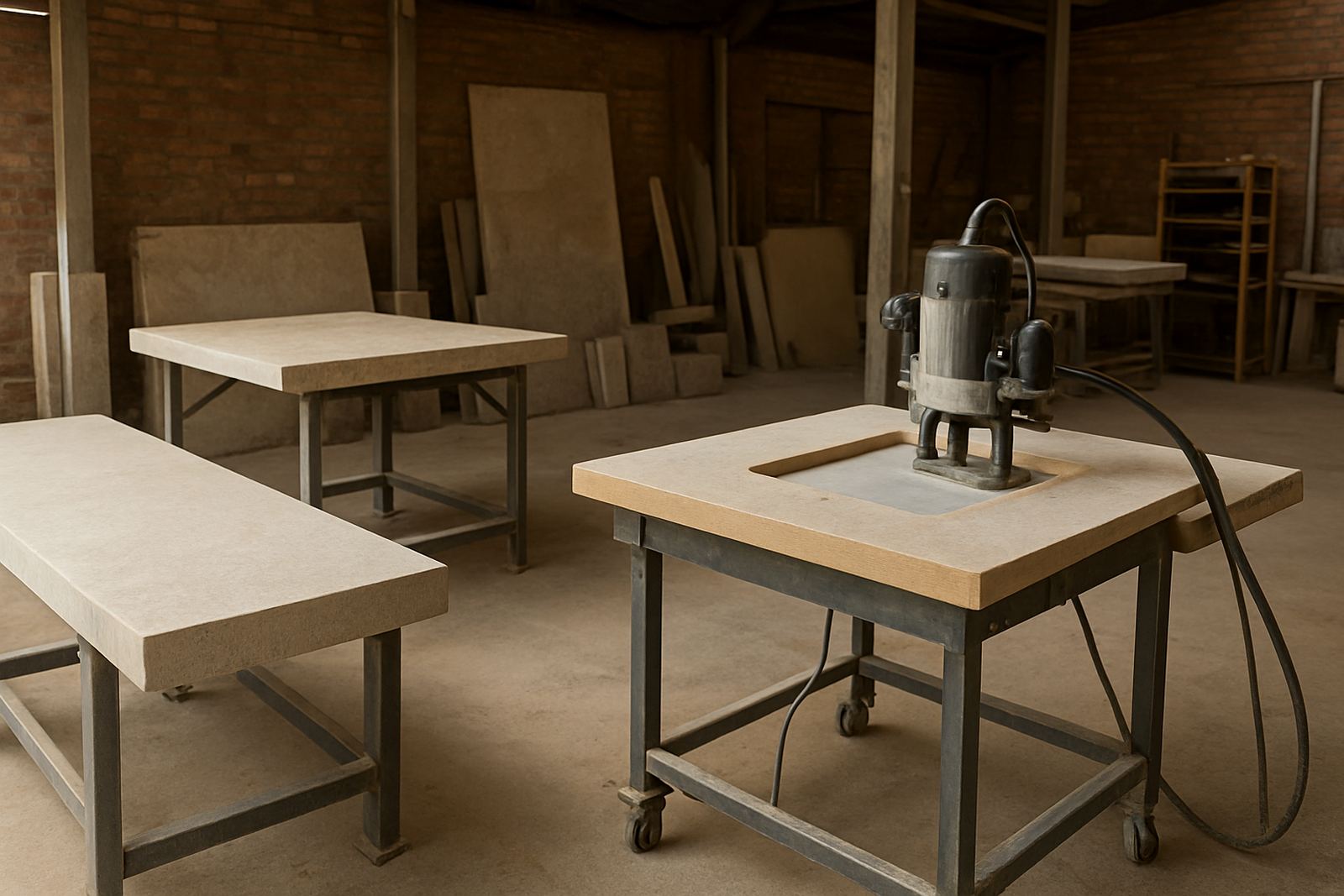
Typical machine set in a countertop and stone workshop
A stone shop might have one CNC router, a bridge saw, a vacuum lifter, a handheld polisher and manual finishing benches, or it may be a more automated line with multiple machines feeding each other. The CAD/CAM side must fit the actual shop layout, not the ideal version. If the slab is loaded from the side wall, or the machine door opens into the aisle, the program flow needs to suit that reality.
- 3 axis or 4 axis CNC router for cut-outs, profiling and drilling
- Bridge saw or gantry saw for rough dimensioning
- Vacuum pods, clamps or nesting beds for slab holding
- Digital templating or manual template conversion into CAD geometry
- Tool setters, tool length probes and a basic tool library
- Dust extraction and water management for the chosen material
We usually start by checking what the machine actually accepts, whether it wants ISO, conversational output or a specific controller format. That decides the post-processor work. On some sites the machine runs well but the output file causes trouble because tool changes, spindle speeds or safe heights are not set the way the controller expects.
Planning the workflow from template to finished edge
Good planning begins before the slab is even lifted. Measure the site properly, confirm edge finishes, allow for sink bowl clearances, and keep a consistent naming system for jobs so the same kitchen does not get saved three different ways. In stone work, a small misread on a template can become a full remake once the cut-out is routed and the stone has already been cut. It is worth slowing down at the programming stage.
For shops doing templated counters, the workflow normally follows a simple path: capture dimensions, check the drawing, place cut-outs, nest the part on the slab, add toolpaths for drilling and routing, then post the file for the machine. If the team handles both routing and manual finishing, the operator must know where the machine stops and where hand finishing starts. That handover is often where poor habits creep in.
- Set a standard tolerance for site templates and digital take-off
- Use one naming method for job numbers, slab colours and customer details
- Build a tool library with actual cutter diameters, not guessed values
- Keep post settings matched to each machine, not copied from another shop
- Plan for load shedding with safe restart points and saved job states
Post-processors and licence setup for stone jobs
Many stone shops run into trouble when software output does not suit the machine controller. A file that works for routing MDF may not suit granite cut-outs or deep profiling. Custom post-processors help with safe retracts, lead-ins, feed changes, spindle control and the sequence of drilling before routing. That matters when you have brittle material, water cooling and a narrow allowance for mistakes.
Licence installation also needs care. If the office computer, programming station and workshop PC are not aligned, staff can lose time moving files, checking activations or wondering which version is current. We help with installation, machine onboarding and post tuning so the shop can move jobs through without extra admin. For sites in humid coastal areas such as Durban or Gqeberha, we also look at backup habits because moisture and dust can shorten the life of workshop electronics.
A basic setup for a smaller countertop shop may be a single programming station, one licence and a training block to get two or three staff comfortable. A larger fabrication shop may need multiple licences, remote support and annual support planning so the team can keep pace when work volume rises before year-end or after a developer contract lands.
Common mistakes we see in stone-cutting workshops
The most common problems are not glamorous. They are usually avoidable setup issues, rushed programming or a weak link between the office and the floor. A shop can have a good machine and still lose money because the post is wrong or the operator is unsure about the next step.
- Using one generic post for several different controllers
- Not checking tool lengths after a cutter change
- Saving templates without clear revision control
- Routing before the slab has been properly clamped or vacuum held
- Assuming the same feeds work for quartz, granite and porcelain
- Leaving no plan for load shedding and mid-job recovery
We also see shops underestimating training. The owner may understand the business, but the programmer and the machine operator still need time on the actual workflow. If the team only learns on production jobs, the learning cost shows up as scrap, delayed deliveries and a lot of stress. A short, hands-on session on real jobs is usually more useful than a long theoretical class.
Budget ranges for stone shops in Rand
Budgets vary depending on how much of the workflow you want to support. A smaller workshop looking for one licence, a tailored post and basic operator training will spend less than a multi-machine shop wanting onboarding, workflow audits and ongoing support. As a practical guide, many stone shops should plan for a setup range from about R25 000 to R85 000 for a focused starter package, depending on the number of users and the level of customisation.
For a growing shop with multiple machines, custom post work, programmer training and first job support, the investment may sit between R85 000 and R180 000 or more, especially where there are several controller types or a need for on-site sessions in Pretoria, Johannesburg, Durban or Cape Town. Annual support plans are often cheaper than repeated emergency fixes because they reduce downtime and help new staff get productive sooner.
If you are comparing options, look beyond licence price alone. The real value is in getting the setup right, the operator confident and the first jobs out cleanly. A cheaper system that causes three scrap slabs in a month is not cheaper at all.
How we support stone-cutting teams across South Africa
We work with stone shops from Centurion and Pretoria through Johannesburg, Vereeniging, the East Rand, West Rand, Durban and Cape Town. Support can include custom post-processors, post tuning, machine onboarding, licence installation, operator training, programmer training, owner training, first job support, remote troubleshooting, workflow audits and tool library builds. For shops with more than one site, we can also help standardise how jobs move between branches.
Many teams start with a workflow audit and a post review. From there we sort the practical items first, then train the people who use the system every day. That usually gives the quickest improvement. If your stone shop is losing time to program errors, inconsistent tool data or unclear machine output, it is usually fixable with the right setup and a bit of focused on-site time.