The Brief From a Boksburg Turning Floor
The client was a busy turning shop in Boksburg handling repeat shaft work for local engineering customers, with jobs ranging from small production batches to urgent one-off repairs. The main pain point was not the machining itself, it was the time lost on setup, inconsistent tool ordering and different operators using slightly different methods from shift to shift.
The brief was straightforward. They wanted a CAM process that would suit their lathe, keep the tool list in the same order every time, and make it easier for the team to load the right programme with fewer mistakes. They also wanted something practical for the shop floor, because their operators do not have time to work through long theory sessions when there are parts on the machine.
- Repeat shaft work with changing diameters and lengths
- Mixed operator experience across day and afternoon shifts
- Need for stable setup sheets and cleaner tool order
- Shorter changeover between repeat jobs
What Got in the Way Before the Rollout
The shop was running under normal Boksburg production pressure, with material coming in when it came in and due dates tied to customer machines waiting on parts. Like many Gauteng workshops, they also had to work around load-shedding and occasional voltage dips, so the process needed to be easy to recover after an interruption. If a job stopped mid way, the next operator had to know exactly where things stood.
Another issue was consistency. Tool names were being recorded differently by different people, and the sequence on the machine screen did not always match the physical turret layout. That led to extra checking, and extra checking means extra time. On a lathe shop floor, even 10 minutes per job adds up fast over a week.
- Tool naming was not standardised
- Setup notes were stored in different places
- Programme handover between operators was awkward
- Restart after power cuts took longer than it should
Our Supply and Implementation Plan
We supplied the client with a lathe CAM licence set up for their workflow, then built a custom post-processor to suit the machine controls and the way their programmers wanted to work. Tiaan handled the post-processor side, while Ompha and Mthunzi worked through the implementation details and on-machine checks. Farieda coordinated technical support during the first job runs, and Phenyo arranged the training sessions so the team could move from software to actual production without guesswork.
The rollout took 3 weeks from start to first production use. Week 1 was the workflow audit and tool review. Week 2 covered the post-processor adjustments, licence installation and test files. Week 3 was on-site training, followed by first job support while the shop ran live parts. We kept the process tight because a turning shop cannot lose half a day to theory when shafts are waiting on the rack.
- Licence installation and user setup
- Custom post-processor built for their lathe format
- Tool library built with standard names and offsets
- Setup sheets adjusted for clear operator handover
- First job support on the shop floor during production
Training Focused on Real Jobs, Not Theory
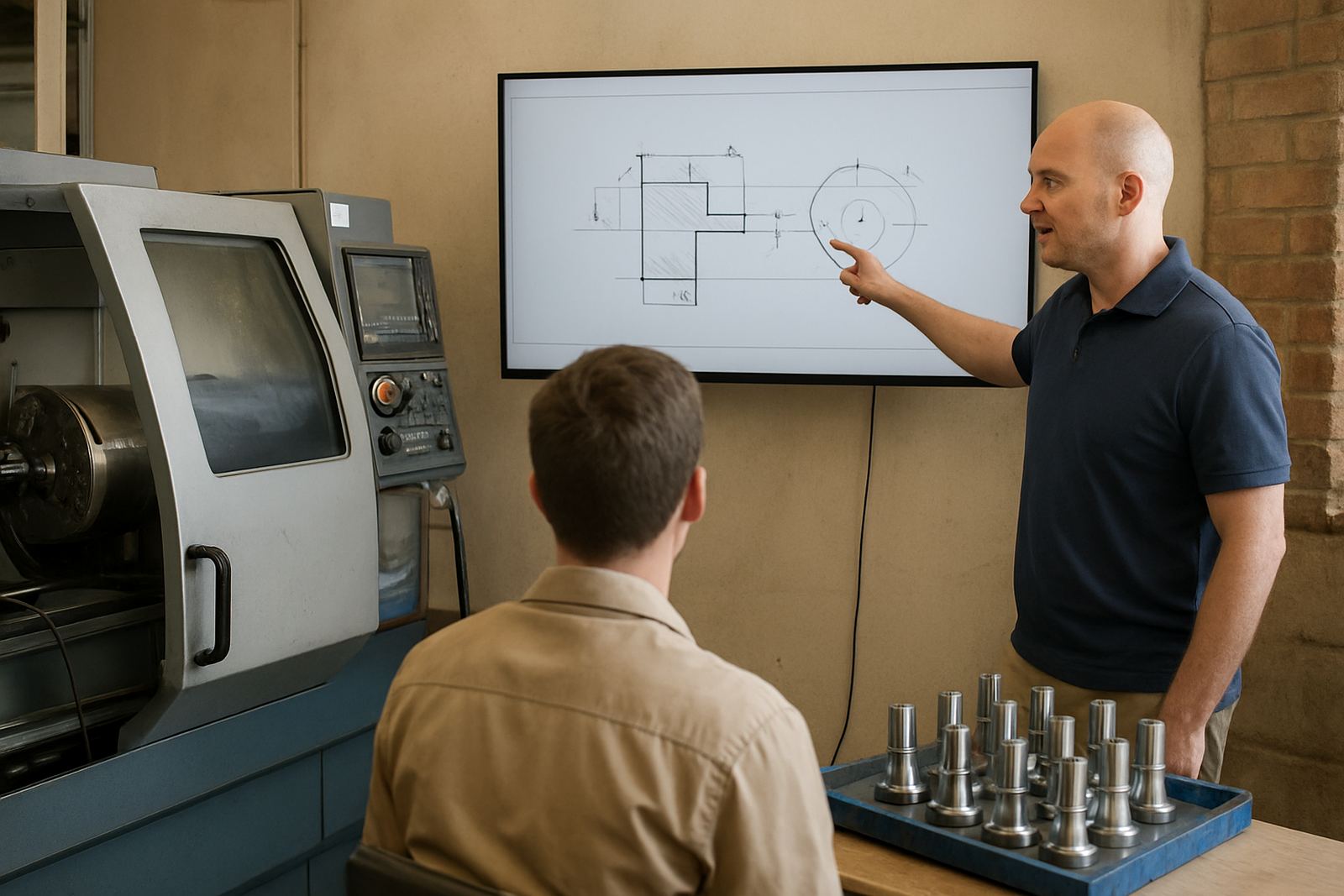
The training was hands-on and built around the actual shaft jobs the client runs every week. We covered programmer training for the CAM side, then owner training so management could understand where time was being lost and how the new workflow would pay back. Operator training focused on loading the correct file, checking the setup sheet, verifying the tool order and confirming safe start-up before cycle start.
We also covered first job support because that is where most teams need the most help. Once the first part is proven, confidence improves quickly. The aim was to leave the shop with a repeatable method that works on a Monday morning and still works at 4 pm when the team is rushing to clear the machine for the next job.
- Programme creation for repeat shaft families
- Tool library naming rules
- Safe verification before cycle start
- Hand-over notes for shift changes
- Simple recovery steps after interruptions
Results on the Machine and in the Planning Room
By the end of the rollout, the client had a cleaner workflow for repeat work and less variation between operators. Setup sheets were easier to read, the tool order matched the machine sequence, and the programmers no longer had to re-check the same details for every shaft family. The shop could move from one repeat part to the next with less friction, which matters when the same customer sends in similar jobs week after week.
The main gains were practical. Changeovers were faster, the risk of incorrect tool order dropped, and the first job on a new batch became easier to prove. They also reported better confidence during power-related interruptions because the notes and programme structure made it simpler to pick up where they had left off. In a shop that works under pressure, that kind of clarity saves real hours.
For a Boksburg operation serving nearby manufacturing and repair customers, that meant better turnaround on standard shafts, fewer small errors and less time spent correcting avoidable setup issues. Not dramatic on paper maybe, but on a turning floor it is the difference between staying ahead and chasing the day.
What We Would Repeat on the Next Turning Job
If we were rolling out the same type of project again, we would follow the same order: audit the real jobs first, standardise the tool naming, build the post-processor around the machine as it is actually used, then train the team on their own parts. That approach works because it starts with the shop floor and not with assumptions.
We would also keep the support close during the first production week. That is the point where small questions come up, and if they are answered immediately the team settles much quicker. For turning shops in Boksburg, Pretoria, Johannesburg or further afield, that steady start is usually worth more than a long classroom session. A few practical steps early on can save a lot of rework later.
- Start with the real production part family
- Standardise the tool list before live use
- Check the machine handover process before training ends
- Stay available during the first batch, not only after it
Key facts
| Town | Boksburg, Gauteng |
|---|---|
| Project type | Lathe CAM rollout for repeat shaft work |
| Timeline | 3 weeks |
| Core services | Custom Post Processors, Licence Installation, Operator Training, Programmer Training, First Job Support |
| Machine focus | CNC turning |
| Main outcome | Cleaner tool ordering, faster setup and better repeatability |